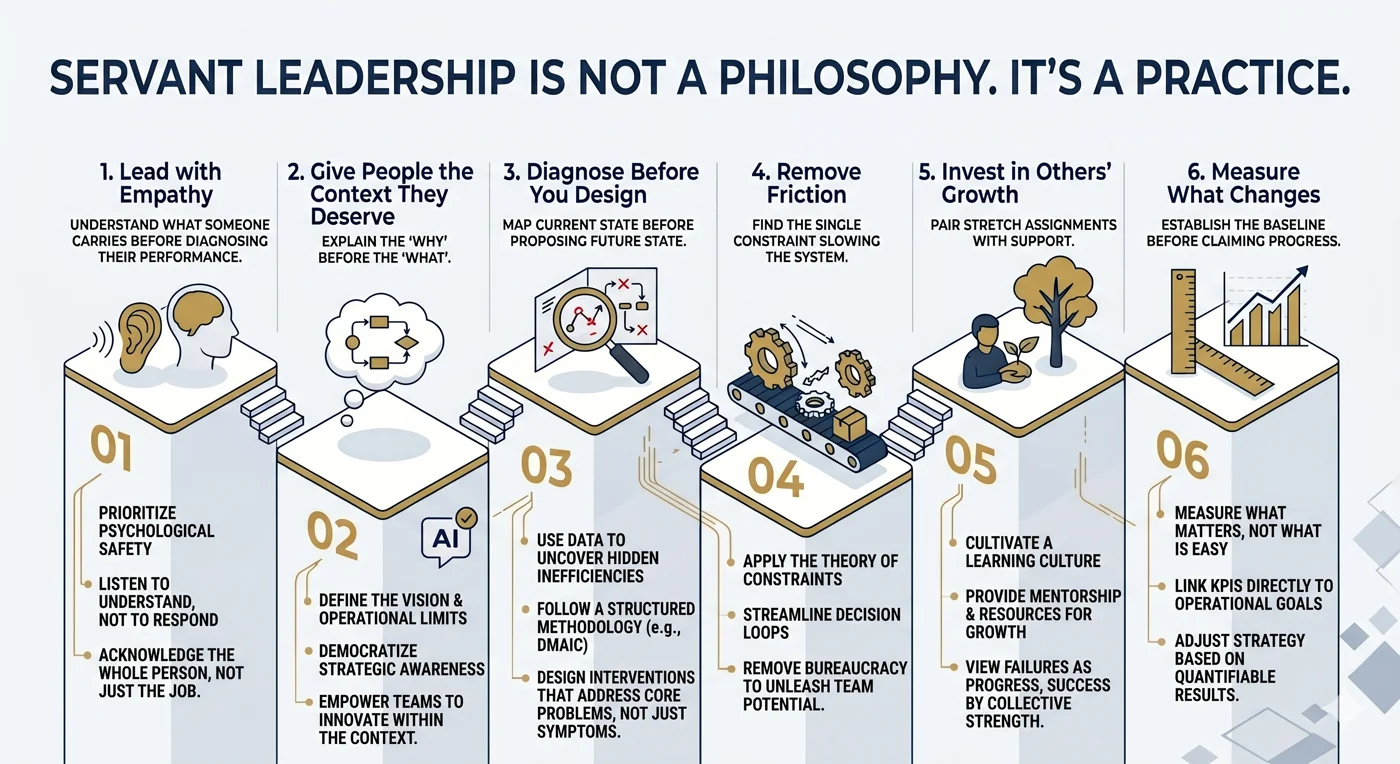
Most leadership frameworks fail at the seam between intention and execution.
A leader reads about empathy and agrees with it. They read about transparency and nod. They believe in investing in their people's growth. But then a quarter closes badly, a project falls behind, or a stakeholder relationship gets complicated — and the first casualty is the framework they said they believed in.
The principles weren't wrong. The practice wasn't there.
I've spent two decades in high-pressure operational environments — workforce planning, enterprise transformation, quality systems — navigating friction alongside talented teams. I've had to earn trust in rooms where results were the only currency. Over that time, six operating principles have held up consistently — not as ideas I agreed with, but as practices that worked when everything else was under pressure.
These aren't principles I invented. They're principles I earned.
01
Lead with Empathy
Understand what someone carries before diagnosing their performance. Context precedes prescription.
Early in my career, I worked alongside a 24x7 technical operations team carrying an invisible weight I almost missed. Attrition was at 50%. Errors were frequent. The surface-level diagnosis was competence. But the real issue was clarity — they didn't have documented processes, shared training, or a mutual understanding of how the work was supposed to flow. They were performing in a system that had never given them the tools to succeed.
The breakthrough wasn't a performance management plan. It was 143 standard operating procedures, built in conference rooms alongside the operators who actually did the work — walking through their day-to-day jobs, diagramming process flows, capturing the if-then-else decisions that only lived in people's heads.
Selected outcomes: attrition dropped from 50% to 1%. Procedural errors fell 86%. Critical outages dropped 80%. All availability targets were met for the first time in the history of the organization.
None of that happened by diagnosing their performance first. It happened by understanding what they were carrying.
Empathy is not softness — it's diagnostic discipline applied to people.
What it looks like in practice:
- Listen before diagnosing
- Name the pressure before proposing a fix
- Hold space when it's uncertain
- Invite challenge — and incorporate the pushback
"He listens to the team members, and pivots when necessary to implement their recommendations."
— Carolyn DeReus, Verizon02
Give People the Context They Deserve
Your team deserves the same quality of context as your best AI prompts. Context determines decision quality.
There's a question I've started asking before every significant communication: Would I trust an AI to act on this information? If the context is incomplete, ambiguous, or missing the "why," the answer is no — and the same is true for the people on my team.
Context isn't just background. It's the difference between a team that executes and a team that thinks. When people understand the constraints, the trade-offs, and the business case behind a decision, they make better calls at every level. They escalate the right things. They protect what matters. They don't burn energy on problems that have already been solved upstream.
Transparency isn't radical candor for its own sake. It's respect expressed as information.
That principle extends beyond your direct team. In process excellence and operational improvement work, every stakeholder carries something urgent. The pressure to treat every request as the top priority simultaneously is constant — and the temptation is to absorb it silently: accept everything, stay vague about timelines, let people assume their work is moving. What that actually produces is a credibility gap that compounds over time.
I learned a sharper version of this through Scrum, which is built on a servant leadership foundation and names transparency as one of its core pillars. The discipline Scrum brought into my practice: make the queue visible. Tell people what's being worked on now, what's waiting, and why the sequencing is what it is. When someone's request isn't at the top of the backlog, they deserve to know — not silence, not vague reassurance, but a direct answer: Your work is in queue. Here's what's ahead of it and why. Here's roughly when we expect to reach it. A clear, honest answer — even a disappointing one — is more respectful than a black hole. Silence implies everything is in motion. Transparency gives people the information to make their own decisions.
Give your people what you give your best AI prompts: full context.
What it looks like in practice:
- Explain the "why" before the "what"
- Share constraints, not just decisions
- Name what you don't know
- Make the business case visible to the team
- Make the backlog visible to stakeholders — and explain the prioritization logic
- Deliver honest sequencing: what's first, what's waiting, and why — even when it disappoints
"His process maps provided clarity to roles and responsibilities — allowing team members to understand how a process flows, where they fit in, and which steps needed to be followed to eliminate duplication of effort between teams."
— John V. Demetrio, Verizon03
Diagnose Before You Design
What appears to be the problem is rarely the actual problem. DMAIC separates signal from assumption.
One of the most expensive habits in organizational life is designing solutions before completing the diagnosis. A process is slow, so we add headcount. A metric is red, so we add a meeting. A project is behind, so we add governance.
In most cases, the intervention addresses the symptom and leaves the root cause intact — which means the problem comes back, usually worse, and now there's an extra meeting attached to it.
Lean Six Sigma disciplines me to hold the hypothesis loosely until the data speaks. That means mapping current state in detail — every handoff, every wait, every decision point — before proposing a future state. It means separating the presenting complaint from the actual constraint. It means interviewing the operators, not just the managers.
One of the most consequential applications of this principle involved a 400-step IT asset lifecycle process carrying tens of millions in annual drag. The symptom was slow cycle times. The root cause: 43% of critical-path steps were unnecessary, along with a third of the handoffs. We didn't streamline the existing process. We eliminated the friction that the existing process had normalized.
Selected outcomes: 82% reduction in critical-path cycle time; ~$40M in annual enterprise expense savings.
Solving the real problem produces what the apparent fix never would.
What it looks like in practice:
- Map current state before proposing future state
- Separate symptoms from root causes
- Interview operators before designing process
- Hold the hypothesis loosely
"The person to turn to when there is a problem or effort so entangled that most do not know where to start, much less how to unravel to a starting point and meet the intended goal."
— Sally Curran, Verizon04
Remove Friction
Automate and eliminate the drag that keeps talented people stuck in low-value tasks. Clear the path.
There is a category of organizational waste that rarely shows up in a budget: the time talented people spend doing work that a well-designed system should be doing for them.
I've watched skilled analysts spend three days every reporting cycle manually comparing spreadsheets — a task that existed only because no one had built the automation. I've watched field technicians drive inefficient routes because the underlying work area geometry had never been rationalized. I've watched operations teams build informal data systems in Excel because the enterprise system didn't give them what they needed.
Each of these is a friction problem. The people aren't the constraint — the system is.
Removing friction isn't just about efficiency. It has a deeper consequence: when people have tools and clarity to do their work well, they stay. That 50% to 1% attrition story isn't just an empathy story. It's a friction story. People don't leave organizations. They leave systems that make it impossible to succeed.
When people have tools and clarity to do the work well — they stay.
What it looks like in practice:
- Find the single constraint slowing the system
- Automate the repeatable; elevate the rest
- Simplify the handoff
- Make the invisible visible with data
"3 days of manual 'stare and compare' automated into a mouse click — 5 minutes."
— Collin Ice, Verizon05
Invest in Others' Growth
Measure success by whether the people around you are stronger for having worked with you — not just by the outcomes you delivered.
This is the principle that is hardest to sustain under pressure — because investing in someone's growth is a long game, and most operational environments are playing a short one.
But it also has the longest tail. The frameworks shared, the stretch assignments paired with coaching, the knowledge transferred instead of hoarded — those compound in ways that a single outcome never could. Teams I've worked with didn't just perform better during the engagement. They were demonstrably stronger after it.
I try to measure this directly. Not as a lagging indicator — "did the outcomes improve?" — but as a leading one: Is this person's capability growing? Do they have something now they didn't have three months ago? The answer to that question is more predictive of sustained performance than any metric I've tracked.
The team that worked with me should be measurably stronger for it.
What it looks like in practice:
- Name what people do well, specifically
- Pair stretch assignments with support
- Share the framework, not just the answer
- Measure the team's growth as a personal metric
"I referred to him as 'the tide that lifts all ships' — due to his support for teammates and his investment in our organization's internal data and processes."
— Jeff Parker, Verizon06
Measure What Changes
Improvement claimed without a baseline is just a story. Rigorous measurement converts intent into evidence.
This is the principle that sits beneath all the others — and the one that servant leadership frameworks most often leave out.
Empathy, transparency, removing friction, investing in growth: all are genuinely human-centered practices. But without measurement, they remain intentions rather than results. And in the organizations I've worked in — high accountability, data-driven, answerable to boards — intentions don't survive the next budget cycle.
The discipline I carry from Lean Six Sigma is this: no improvement is claimed without a defensible baseline. The story of what changed is the delta from that baseline — not an assumed prior state, not a narrative constructed after the fact.
This discipline also protects the people doing the work. When outcomes are measured and attributed honestly, teams get credit for what they actually accomplished. When improvements are claimed loosely, no one's contribution is ever truly seen.
Data doesn't just prove the outcome. It earns the next investment.
If you can't measure the delta, you can't own the result.
What it looks like in practice:
- Establish the baseline before claiming progress
- Build measurement infrastructure alongside the solution
- Make KPIs visible to the people doing the work
- Attribute outcomes with rigor — not just narrative
"The critical reporting to build robust, data-backed business cases — for headcount decisions in both directions."
— Kristine Reelfs, Verizon GNO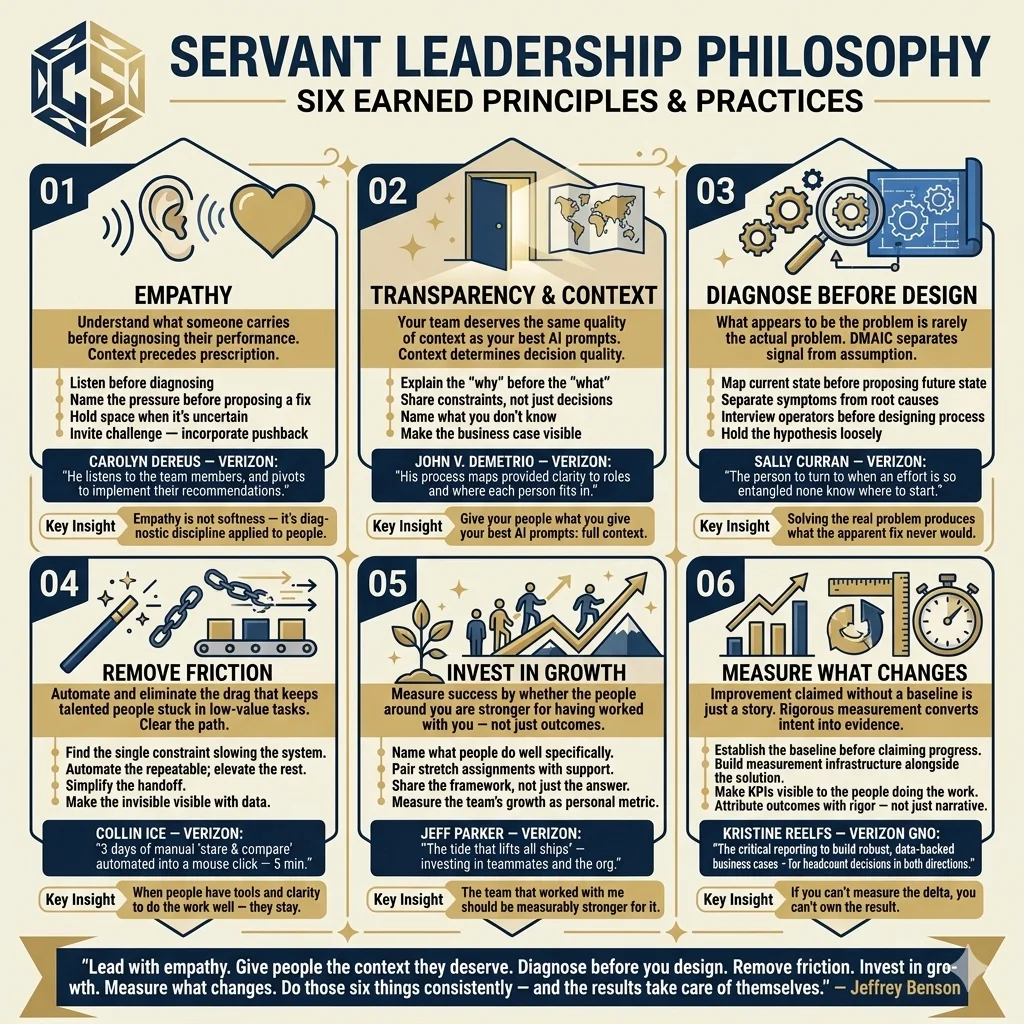
Six earned principles — not claimed through intention, but proven through practice.
The Practice
These six principles didn't emerge from a leadership book. They emerged from two decades of navigating operational complexity alongside people who were carrying weight that deserved to be taken seriously.
They've held up in 24x7 operations centers and in SVP-level executive reviews. In workforce planning models and in conference rooms where I was building process documentation alongside technicians. In Lean Six Sigma project charters and in quiet conversations about what a team actually needs to succeed.
What I know from experience: none of the six works in isolation. Empathy without measurement produces well-intentioned guesswork. Measurement without empathy produces a surveillance culture. Removing friction matters most when you understand what the person doing the work is carrying. Investing in growth lands differently when the context is transparent.
Together, they form something coherent.
I want to be honest about something. I haven't lived these six things perfectly, and I won't claim otherwise. There have been moments — under deadline pressure, in difficult stakeholder conversations, in seasons when I moved too fast — when I skipped the diagnosis, shortcut the context, or let measurement slide until after the fact. What I can say is that the moments I've struggled most have also been the moments these principles called me back. That's what a practice does. It gives you something to return to.
What's the hardest of these to sustain when the pressure is on? I'm curious what breaks down first — and what's helped you hold it.